A kitten in a new home goes looking for a corner to dig in, and she'll take the first one she can climb into, box or laundry pile. Make it the KittyGoHere 2.0: it has two doorways 3 inches off the floor, low enough for short legs, and at 22.5 inches long it still fits a small to mid-size adult, for about $50. A big cat will want a longer box later.
That's a lot to spend on a kitten under eight weeks, or on a foster litter that moves on in a month. For those, a box you outgrow or throw away makes more sense, and both are in the list.
You're bringing home a kitten of eight weeks or more and you'd rather buy one box than two.
Skip it if
Your kitten comes from a big breed. Once she's past 15 inches from nose to tail base, she'll need a longer box.
A kitten box is often bought twice: a small pan now, a real box a few months later. This one is built to skip the second purchase. KittyGoHere sells it for kittens and for older cats with stiff joints, which come down to the same need, a step low enough to walk over. With two doorways she can come in from either side, and the back and side walls rise to 6 inches to keep her digging inside.
The Petmate pan below costs a fraction of the price and does the job just as well for the first weeks. What decides it is the size: by International Cat Care's rule (a box one and a half times the cat's length, nose to tail base), the Petmate's 14 inches suit a kitten of about 9 inches, while the KittyGoHere's 22.5 inches suit a cat of 15. KittyGoHere sizes it for cats up to 20 pounds.
For a long cat later
If she grows past 15 inches from nose to tail base, move her to a box long enough for a grown cat and keep this one as a second box.
Where it falls short
Two low doorways are two places for litter to come out, so a mat in front of each helps.
At 22.5 inches it's shorter than the boxes I'd give a big adult cat.
2Cheapest that works
2. Petmate Basic Litter Pan, Small
A shallow 14-inch pan with 3.5-inch sides, recommended on its Amazon listing for kittens and small cats.
Your kitten is under eight weeks, and you want a box tonight for very little.
Skip it if
You want a box she'll still use at a year old. At 14 inches long, she'll outgrow it.
For about $6, this is the shallow pan most people start with, and its Amazon listing recommends it for exactly that: kittens and small cats. Its sides are 3.5 inches high all the way around, so a kitten can step in anywhere, and it's 14 by 10.5 inches, big enough for a young kitten to turn around. It's made in the US, and it costs so little that a second one for the far end of the house is an easy call.
Where it falls short
Kittens dig with more enthusiasm than aim, and 3.5-inch sides don't keep much in.
3Best disposable
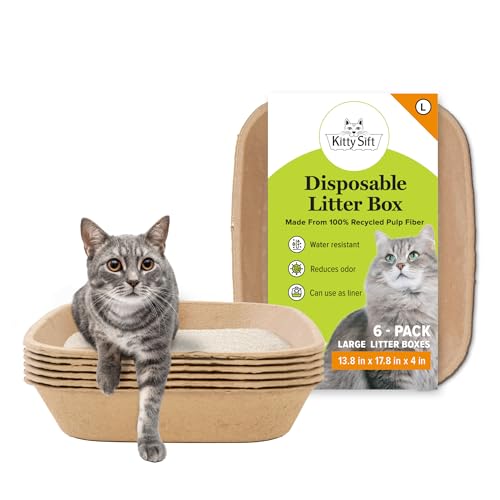
3. Kitty Sift Disposable Litter Box, Large (6-pack)
Recycled-cardboard trays with 4-inch sides that go out with the trash every two or three weeks.
You're fostering a litter, or the kitten is with you for a few weeks before she goes to her home.
Skip it if
You want one box for years. These are made to be thrown out.
Kitten Lady, the kitten rescue educator, suggests a cardboard tray for kittens under eight weeks, and these are that idea made sturdier. Each tray is 13.8 by 17.8 inches with 4-inch sides, made from water-resistant recycled cardboard, and the maker says to replace it every two or three weeks. A pack of six covers three or four months at that pace.
Where it falls short
It's a box you keep buying, six at a time.
The 4-inch sides are a stretch for a three-week-old; a cardboard flat from canned kitten food comes first.
Read more about the Kitty Sift traysShow less
When the litter goes to new homes, the trays go out with the trash instead of being scrubbed for the next one.
4Best for a small room
4. KittyGoHere Senior Litter Box, Small
The same 3-inch step as the bigger KittyGoHere boxes, on a pan 20 by 15 inches.
The box has to go in a bathroom or a corner too small for the KittyGoHere 2.0.
Skip it if
Your kitten will grow into a big cat. KittyGoHere sizes the Small for cats up to 6 pounds.
At 20 by 15 inches, the Small takes less floor than the 2.0 and keeps the same 3-inch step, just with one way in instead of two. Its walls are 5 inches high, so a kitten still sees out while she digs, and they keep more litter in than the Petmate's 3.5-inch sides.
Where it falls short
It's the priciest box here that a kitten outgrows.
Read more about the KittyGoHere SmallShow less
With that 6-pound limit, it's a box for her first months and for a small adult, at nearly the price of the 2.0. Over the Petmate, you're paying for those walls, the low step and a pan 6 inches longer, in a spot where the 2.0 won't fit.
5Best steel for a kitten
5. Amibud Low Entry Stainless Steel Litter Box
A steel tray with rounded corners and sides under 3 inches, the lowest step of the five.
Plastic pans keep smelling after you've washed them, or you want a box you can scrub hard.
Skip it if
Your kitten already digs hard. Sides this low barely slow the litter down.
It's a steel tray you can take to the bathtub and scrub as hard as you like (steel or plastic has the longer story), and its sides are 2.76 inches, the lowest of the five, low enough for a kitten in her first weeks with the box. It's 17.7 by 13.8 inches with rounded corners and no sharp edges.
Where it falls short
With walls under 3 inches, plan on a litter mat around it.
Read more about the AmibudShow less
Amibud isn't a name you'll find on pet shop shelves, and it publishes nothing beyond the Amazon page. For a tray this simple, that matters less than it would for a box with moving parts.
Not a clumping one, at first. Kittens explore with their mouths, and Kitten Lady advises against clumping litter until a kitten is at least two or three months old and used to the box, since it's a risk if she eats it. A natural pellet litter, pine or paper, is what she suggests instead, unscented.
Somewhere she can't miss it. Kitten Lady keeps kittens of three to eight weeks in one room with their box, then, as they get the run of the house, makes sure there's a box within about 10 feet wherever they are. Kittens head for corners, so a clear corner is a good start, and a puppy pad under the box saves the floor while she learns. Scoop at least twice a day, International Cat Care's rule: a kitten will skip a dirty box sooner than you think. If she pees on the bath mat or a pile of laundry anyway, the cat litter and litter box page points to the guide for that problem.
When to move up to a full-size box
When she sits on the rim, or her tail hangs over the edge while she goes. Measure her from nose to the base of the tail and find that length in the litter box size table.
Can a kitten use a self-cleaning litter box?
Not in automatic mode until she's past the maker's minimum, around 3 pounds and 6 months for the robots we list. The figures for each one, and how to run it by hand meanwhile, are in the cheap self-cleaning box guide, under kittens.
What to look for in a kitten litter box
A step she can walk over
Three or four inches for a kitten of eight weeks or more; lower, or a cardboard lid, before that.
Open on top
A kitten has to find the box and see out of it; a hood comes later, if she wants one.
Room to grow
Long enough for her by the size table, today and in six months.
Cheap enough for two
A second box at the other end of the house matters more than a fancy first one.
Bowls, scoop and liners in one box, which is handy, but the framed pan stands 7.5 inches tall. That's a climb for a small kitten; buy the pan for later and a low tray for now.
A hood and a swinging door are two things between a kitten and the box she's still learning to find. Start open; a hood can wait until she's grown and shows she likes privacy.
So Phresh Open Kitten Litter Box
This one is sold only at Petco, not on Amazon. It's about the size of the Petmate pan, which does the same job for less.
Also compared: Frisco Senior & Kitten Litter Box, Van Ness Small Cat Pan, Kitty City Kitten Starter Set, Kitty Sift Disposable Litter Box, Jumbo and Petmate Basic Litter Pan, Medium. KittyGoHere Senior Litter Box and IRIS Large High Sided Litter Box are both ranked in the best litter boxes.
How I picked
A step of 4 inches or lessOpen topSize from the makerRoom to grow
Save it for laterPin this guide and find it again when you are ready to buy.Save to Pinterest
Common questions
What kind of litter box is best for kittens?+−
An open, shallow box with a low way in, 3 to 4 inches, so she walks in instead of jumping. The KittyGoHere 2.0 has two doorways at 3 inches and stays big enough as she grows.
At what age should a kitten start using a litter box?+−
At about three weeks. Before that, a mother cat (or whoever is bottle-feeding) stimulates the kitten to go, and Kitten Lady starts the box at three weeks, adding that every kitten gets there at her own pace.
What will attract a kitten to a litter box?+−
A clean box she can always reach. Keep her in one room with it at first, put it in a corner, scoop it at least twice a day, and clean any accident spot well so the smell doesn't draw her back there.
Should a kitten litter box have a lid?+−
No. A kitten needs a box she can find and walk into, and a hood or a door gets in the way of both. If your cat turns out to like privacy, a covered box can come once she's grown.
How many litter boxes does a kitten need?+−
One, while she lives in a single room. Once she has the run of the house, add boxes so one is never more than about 10 feet away; a cheap pan does fine as the second.
The verdict
The one she keeps
Get the KittyGoHere 2.0 once she's eight weeks old, and measure her nose to tail base on her first birthday: past 15 inches, she's ready for a bigger box, and this one becomes the spare.