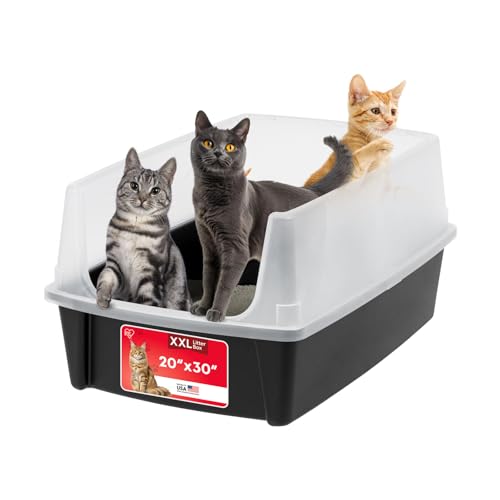
If the box goes in a bathroom you share, two problems show up within a week: litter on the tiles, or a cat perched on the rim because there's no room to turn around inside. The IRIS XX-Large solves both for about $30. It's 30 inches long with 14-inch walls, so most big cats have room to dig, though it also takes a real piece of floor and more litter to fill than the pan you're replacing.
When 30 inches won't fit, the IRIS Large is the same idea at 19 inches and about $18. An older cat who hesitates at the edge of the box needs the 3-inch step of the KittyGoHere more than anything else. And whatever box you choose, the litter you put in it decides as much of the smell as the box does.
You have a cat of ordinary size or bigger, or two cats who share, and the floor space for a box 30 inches long.
Skip it if
Your cat is arthritic. The 6.5-inch front is a step up, not a walk in.
Key specs
Type
Open, high-sided
Size
30 × 20 × 14 in
Way in
6.5 in curved front
Read more about the IRIS XX-LargeShow less
International Cat Care, the feline welfare charity, puts the ideal box at one and a half times your cat's length from nose to the base of the tail, and says many standard boxes are too small. For a cat 18 inches long, that's 27 inches of box, and it's the reason this one is first: it's one of the few under $50 that clears the bar.
The walls are 14 inches high, with a curved cut-out at the front about 6.5 inches off the floor. IRIS sells it for Maine Coons, Ragdolls and homes with more than one cat, and the open top means you see at a glance when it's time to scoop.
Before you buy it
Measure the spot first. Thirty by twenty inches is about what a bath mat covers, and the box needs a few inches of clearance at the front for the way in.
Flaws but not dealbreakers
It fills with more litter than a standard pan, so a bag goes a little less far.
The curved front is the only low point, so there's one way in and out.
30 in longOpen top
2Best compact box
2. IRIS Large High Sided Litter Box
Best for: A small bathroom or a small cat
The same tall, open design at 19 inches long, with a scatter shield that lifts off for cleaning.
Your bathroom is small and so is your cat, or you need an extra box for a tight spot.
Skip it if
Your cat is long or heavy. At 19 inches, a big cat ends up with its back half hanging out.
Key specs
Type
Open, high-sided
Size
19 × 15 × 11.75 in
Way in
Low front cut-out
Read more about the IRIS LargeShow less
The 19-inch version has the same tall walls, at almost 12 inches, and a scatter shield that lifts off so you can tip the box out without fighting it. It's a good extra box, too: two cats need three boxes, and this is the one for the spot where an XX-Large won't fit.
I'd only make it the main box for a cat under about 13 inches nose to tail, which by the one-and-a-half rule is the cat it really fits.
Flaws but not dealbreakers
Too short for a large cat, whatever the walls.
The shield is a separate piece, one more thing to rinse at the full change.
19 in longRemovable shield
3Best top-entry
3. Modkat XL
Best for: Cats who dig hard or spray high
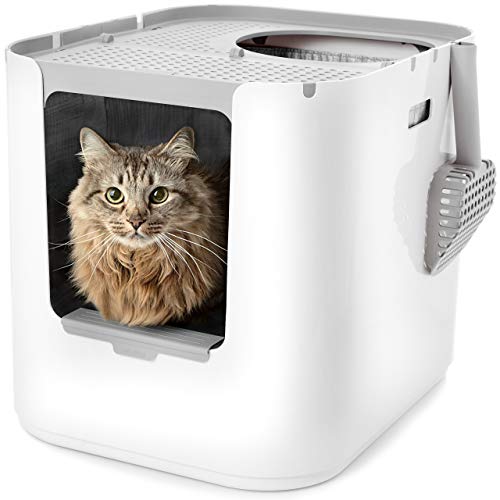
Sets up as top-entry or front-entry, and the lid doubles as a mat that catches litter off the paws.
Your cat kicks litter onto the wall, or pees standing up and over the edge.
Skip it if
Your cat is old, stiff, or a kitten, unless you set it up front-entry.
Key specs
Type
Top or front entry
Size
21 × 16.5 × 17 in
Way in
Top, or 6.25 in front
Read more about the Modkat XLShow less
At about $190 this costs six regular boxes, and I'd still buy it for one kind of cat: the digger who sprays litter across the room no matter how high the walls are. In top-entry mode, your cat climbs through a 10.25-inch hole in the lid and walks out across the lid, which works as a mat and takes most of the litter off the paws. Modkat says it keeps floors "practically pebble free."
It also sets up front-entry, with the doorway 6.25 inches off the floor, and Modkat recommends that for kittens and seniors. Inside goes a reusable tarp liner that the maker says lasts up to three months.
Flaws but not dealbreakers
The price, by a wide margin.
At 21 inches long, it's roomy for a top-entry box but shorter than the IRIS XX-Large.
Top or frontReusable liner
4Best for senior cats
4. KittyGoHere Senior Litter Box
Best for: Stiff hips and older joints
A roomy open pan with a 3-inch entrance, so an older cat steps in instead of climbing.
Your cat is older, moves stiffly, or has started going right next to the box.
Skip it if
Your cat digs hard or sprays high. Low walls keep nothing in.
Key specs
Type
Open, low entry
Size
Large
Way in
3 in step
Read more about the KittyGoHereShow less
A cat with sore hips rarely limps at the box. She just starts going beside it, because the lip is a little too high to bother with. The Merck Veterinary Manual says older cats with arthritis may need a box with lower sides, and the KittyGoHere's entrance is 3 inches, low enough to step over without bending much. It's open on top, the maker says it's roomier than a standard box, and it's made in the US.
If your cat has stopped using the box, see the vet before you buy anything; going outside the box can have a medical cause.
Flaws but not dealbreakers
About $45 for what is, in the end, a plastic pan.
Scatter goes over the low front, so put a mat in front of it.
3 in entryOpen top
5Best covered box
5. Petphabet Jumbo Hooded Litter Box
Best for: A cat who likes privacy
A hooded box nearly 25 inches long with an open doorway and no flap, and a clear lid that lifts off.
Your cat likes to hide, or the box sits somewhere guests can see it.
Skip it if
You'd forget to scoop a box you can't see into. A covered box hides the mess from you too.
Key specs
Type
Covered, clear lid
Size
24.8 × 20 × 16.5 in
Way in
8.2 × 7.8 in doorway
Read more about the PetphabetShow less
Most covered boxes have two problems: they're small inside, and they come with a swinging flap. International Cat Care says big cats find small hooded boxes hard to use and that a flap can put some cats off. The Petphabet avoids both. It's 24.8 inches long and 20 wide, and the doorway is an open 8.2 by 7.8 inches with nothing to push through.
The lid is clear and lifts off whole, so the inside doesn't feel like a cave and scooping doesn't mean unlatching anything.
Flaws but not dealbreakers
At about $60, it's twice the IRIS XX-Large, and five inches shorter.
It's big all around: 16.5 inches tall needs a corner without a shelf.
No flap doorLift-off lid
6Best stainless steel
6. iPrimio Stainless Steel Litter Box with Enclosure
Best for: Plastic boxes that keep smelling
A steel pan that doesn't soak up smells the way plastic does, with a removable 6-inch wall.
You've thrown out plastic boxes because the smell stuck in them.
Skip it if
You scoop with a metal scoop. It scratches the nonstick coating.
Key specs
Type
Stainless steel
Size
23 × 15.5 × 6 in
Way in
Over 6 in sides
Read more about the iPrimioShow less
Plastic boxes get replaced every so often (the Merck Veterinary Manual says old boxes should be); a steel one is meant to stay. iPrimio says its pan won't take on smells or stains the way plastic does, and the nonstick coating lets clumps slide off. The pan is 23 by 15.5 inches and 6 inches deep, and a detachable 6-inch wall goes on top for cats who kick.
What owners report
A few owners say clumps still stick in the corners, so the nonstick finish cuts down the scraping without ending it.
Flaws but not dealbreakers
Use a plastic scoop, or the coating wears.
Small brown marks from production can show on the steel; iPrimio says they're normal.
Steel panClip-on wall
7Best for kittens
7. Petmate Basic Litter Pan, Small
Best for: The first few months home
A shallow 14-inch pan with 3.5-inch sides a small kitten can climb over, for about $6.
You're bringing home a kitten small enough to sit in your hand.
Skip it if
Your cat is grown. At 14 inches, it's a kitten box and nothing more.
Key specs
Type
Open, shallow
Size
14 × 10.5 × 3.5 in
Way in
3.5 in sides
Read more about the Petmate panShow less
About $6 buys the box a young kitten can actually use: 14 by 10.5 inches, with sides 3.5 inches high, low enough to climb over. Petmate sells it for kittens and small cats. Your kitten will outgrow it in a few months, and that's fine at this price.
Flaws but not dealbreakers
Low sides keep little litter in once a kitten starts digging hard.
Too small to be your only box once the kitten grows.
3.5 in sidesAbout $6
Covered or open litter box?
Open, for most cats. The Merck Veterinary Manual says open boxes get more air and some cats won't go into an enclosed space, while others like the privacy of a hood. International Cat Care adds that a cover keeps the smell in for you but can leave the inside smelling worse to your cat. If you're unsure, put an open box and a covered one side by side for a week and let your cat choose.
Best litter box for odor control
A box smells while it waits to be scooped, so the best box for odor is the one that's easy to scoop every day. A big open box like the IRIS XX-Large gets more air than a covered one, and a hard-clumping, unscented clumping litter keeps urine from soaking to the bottom. If plastic boxes keep smelling after you've washed them, the iPrimio is the fix: steel doesn't hold on to it.
Best litter box for multiple cats
The Merck Veterinary Manual's rule is a box more than you have cats, and one on every floor of the house. Two cats means three boxes, and they don't all have to be the same. One XX-Large in the main room and two Large boxes in tighter spots costs about $66 together.
Best litter box for large cats
Measure your cat from nose to the base of the tail, then multiply by one and a half: that's the box length to aim for. A 20-inch cat wants about 30 inches, which is exactly the IRIS XX-Large; a longer Maine Coon needs more than any box sold as standard, so give it the biggest you can fit. Big cats and covered boxes don't mix unless the hood is big, which is why the Petphabet is the only covered box here.
Kitten litter box
A kitten needs sides it can climb over, and that's the Petmate pan at 3.5 inches. Put it somewhere quiet and away from the food bowl, then move up to a full-size box once your cat can hop in easily.
Top-entry litter boxes
They're great for one kind of cat, the vigorous digger or the high sprayer, and wrong for kittens, older cats and anyone heavy or stiff. If you want one but your cat is getting on, the Modkat's front-entry setup is the way around it.
Stainless steel or plastic?
Plastic is cheaper and lighter, and fine for years if you replace it when it starts to hold a smell. Steel costs more once and doesn't stain or hold odor, which matters most in a box that gets heavy use.
Self-cleaning litter boxes
They're a different purchase: several times the price of any box here, and most need a clumping litter so the rake can sift it. For a cat who is happy with a regular box, a big open one and a daily scoop do the job for a fraction of the cost. If you'd rather stop scooping, the best self-cleaning litter boxes are sorted by the weight of cat each one is built for, and there are good self-cleaning boxes under $200 too.
Who this is for
This is for anyone buying a regular litter box for an indoor cat, whether it's a first box for a kitten or the third for a household of two. If you'd pay to never scoop again, a self-cleaning box is the other road. Litter, boxes and the self-cleaning kind are together under cat litter and litter boxes; the rest of what your cat uses every day is in the cat gear guides.
What to look for in a litter box
Long enough for your cat
One and a half times nose to the base of the tail. Most boxes sold as standard are shorter.
A way in your cat can manage
Low for kittens and older cats, high walls or a top hole for diggers.
Easy to scoop
An open top or a lid that lifts off whole. The box you scoop often smells least.
Walls that keep litter in
Tall sides or a top entry if your cat kicks; a mat in front either way.
The right number, not the fanciest
Three plain boxes for two cats do more than one expensive box.
Roomy for the price, but it comes with a swinging door, and a flap is exactly what puts some cats off a covered box. The Petphabet has an open doorway.
How I picked
Length for the catA way in that suits the catEasy to scoopLitter stays inPrice
I picked the boxes I'd put in a real home, each for a different cat: a kitten, a senior, a Maine Coon, a digger, a cat who wants privacy. Size comes first, because a box that's too small is the most common problem and the easiest to avoid.
Save it for laterPin this guide and find it again when you are ready to buy.Save to Pinterest
Common questions
What litter box do vets recommend?+−
A big one. The Merck Veterinary Manual says larger boxes are better, since cats like room to dig and turn, and that older cats with arthritis may need lower sides. International Cat Care puts the ideal length at one and a half times your cat, nose to the base of the tail.
Are top entry litter boxes good for cats?+−
For young, healthy cats who kick litter or spray high, yes: almost nothing gets out. For kittens, seniors and heavy cats, no, because the jump in and out is hard on them. A box like the Modkat XL can be set up either way.
Do cats prefer closed or open litter boxes?+−
It varies, but open is the safer start. Open boxes get more air, and some cats avoid enclosed spaces, while others like the privacy of a hood. Offer both for a week if you're not sure.
Do I really need 3 litter boxes for 2 cats?+−
That's the usual rule: one box per cat plus one. It keeps a clean box free when one cat is using the other, and it matters most if your cats don't get along.
What size litter box does a large cat need?+−
About one and a half times its length, nose to the base of the tail. For a big cat that's around 30 inches, the size of the IRIS XX-Large.
The verdict
Which box for which home
A kitten in a studio: the Petmate pan for the first months, then the IRIS XX-Large for good. Two grown cats in a house with stairs: an XX-Large on each floor and a Large as the third box, and keep the money you'd have spent on a covered one for litter.